


Glow Again Barrier-Repair Moisturizer
Glow Again Barrier-Repair Moisturizer
Formulated For Pregnancy
100% Satisfaction Guaranteed
Free Shipping & Returns
Glow Again Barrier-Repair Moisturizer
Couldn't load pickup availability
GLOW AGAIN BARRIER-REPAIR MOISTURIZER
This isn't a light hydrating cream. It's a barrier-repair moisturizer designed to heal pregnancy-damaged skin while controlling sebum.
Why Glow Again Barrier-Repair Moisturizer Works:
When your barrier is broken, your skin over-produces oil to compensate. You then strip it more to fight the oil. This
creates a self-feeding loop — the Barrier-Sebum Spiral.
Most acne moisturizers are too light to actually repair a broken barrier. Most barrier-repair moisturizers are too heavy for oily, acne-prone skin.
Glow Again Barrier-Repair Moisturizer is both:
Heavy enough to heal, light enough to not trigger breakouts.
While using widely approved ingredients for pregnancy.
Main Ingredients
Main Ingredients
- Niacinamide 5% (Sebum control + barrier strengthening)
- Hyaluronic acid (Deep hydration + barrier support)
- Ceramides (Barrier repair, locks in moisture)
- Squalane (Mimics skin's natural oils)
- Glycerin (Hydration)
- Zero fragrance
- Zero essential oils
How To Use
How To Use
Use AM and PM everyday.
Step 1: Wash your wash with pregnancy-safe cleanser.
Step 2 (Optional): Apply pregnancy-safe serum
Step 3: Apply pea-sized amount to entire face.
If skin is stil dry after a few minutes, apply slightly more product.
Free Shipping & Returns
Free Shipping & Returns
Shipping and handling are free for all paid orders at least $60 within the United States.

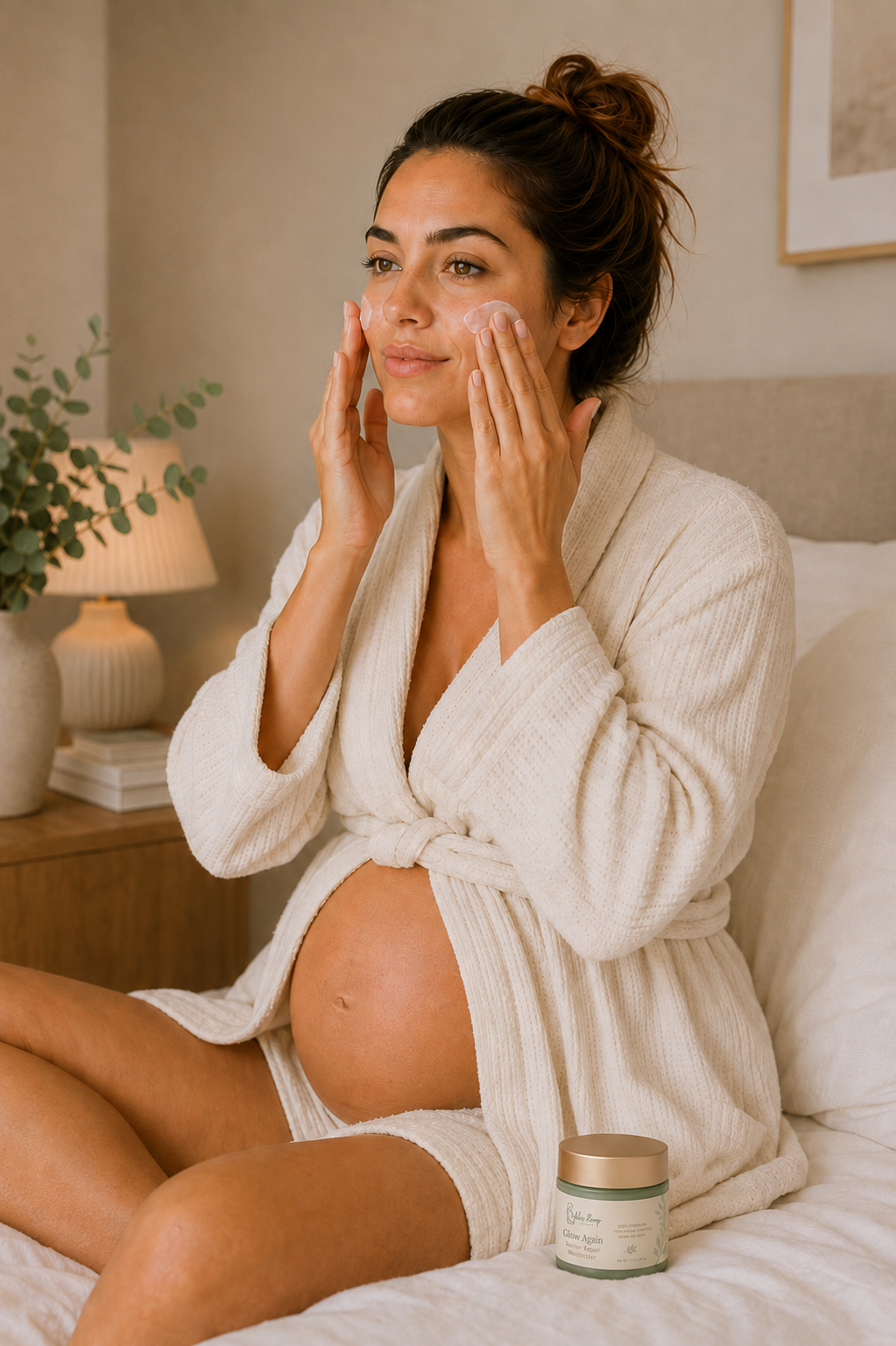

Hydrated Skin. Happy Baby.
How Glow Again Barrier-Repair Moisturizer Works:
- Strengthens: Ceramides rebuild the protective lipid layer that pregnancy hormones break down.
- Hydrates: Hyaluronic acid draws and locks in moisture, calming tight, dehydrated skin.
- Balances: Niacinamide regulates oil production so your skin stops overcompensating.
- Protects: A restored barrier means fewer irritants in, less inflammation, and less rebound breakouts.
And it's formulated to only use dermatologist and OBGYN approved ingredients.

Improvement Timeline
Your progress timeline can look different. This is not a guarantee of results. Everyone is different.
BBSC Glow Again Barrier-Repair Moisturizer
compared to others
| Baby Bump Skincare | Others | |
|---|---|---|
| Formulated For Pregnancy | ||
| Repairs Your Skin Barrier | ||
| Works for Oily AND Dry Skin | ||
| Fragrance-Free |
Frequently Asked Questions
Your skin barrier is the outermost layer of your skin — a complex structure of cells and lipids that keeps moisture in and irritants out.
When this barrier is damaged (by hormonal changes, harsh products, over-cleansing, or environmental stress), two things happen.
First, your skin loses water faster, so it feels dry and tight.
Second — and this is the crucial part for acne — your skin compensates for the damage by over-producing oil. That rebound oil is exactly what feeds more breakouts.
Most acne treatments focus only on removing oil. But if you don't repair the barrier, the oil keeps coming back.
That's the Barrier-Sebum Spiral. Glow Again Barrier-Repair Moisturizer breaks that cycle from the foundation up.
All the ingredients are all widely considered to be pregnancy-compatible by dermatologists.
However, because skincare products cannot be tested on pregnant women, no one can safely say any ingredient is "proven safe" in pregnancy.
If you have any concern, please consult a physician before usage.
Yes. The formula absorbs without leaving a heavy film, which makes it compatible as a makeup base. Apply it, wait 2–3 minutes to fully set, then apply foundation or SPF as normal. If you're using a heavy full-coverage foundation, you may want to use a slightly thinner layer of the moisturizer to avoid any pilling. If you're using a lightweight BB cream or tinted moisturizer, it layers seamlessly.
If you are not 100% satisfied, we have a lifetime satisfaction guarantee. Just email [email] with your proof of purchase and we will take care of things.
If you have an existing skin condition — especially one that's been newly diagnosed or has worsened during pregnancy — please speak with your dermatologist before introducing any new moisturizer, including this one. Ceramides are actually a front-line recommendation for eczema patients, and niacinamide is well-tolerated in most skin conditions. However, please consult to your doctor first before usage.
Always after the serum. The correct order is:
- Cleanser (removes oil + impurities)
- Azelaic Acid Calm Serum (treatment step — needs direct contact with skin)
- Barrier-Repair Moisturizer (seals in the serum + repairs the barrier on top)
Applying the moisturizer before the serum would create a barrier that reduces how much azelaic acid penetrates your skin — which defeats the purpose. The serum goes first on clean skin, always.
They do different jobs. Ceramides are the physical building blocks of your skin barrier — they're literally the lipids (fats) that hold your skin cells together and keep moisture locked in. Supplementing them topically helps rebuild a barrier that's been stripped or damaged. Niacinamide (vitamin B3) works differently — it's a signal molecule that tells your skin cells to produce more ceramides naturally, while also regulating sebum production and reducing inflammation. Using them together means you're both directly rebuilding the barrier (ceramides) AND signaling your skin to maintain it long-term (niacinamide). Each alone is good. Together, they're significantly more effective.